
搜索历史清除全部记录
- All
- Product Management
- News
- Introduction
- Enterprise outlets
- FAQ
- Enterprise Video
- Enterprise Atlas

Disappearing passenger terminals, and bus companies in transition
Tiempo de lanzamiento:
Oct 11,2022
 "Haven't been on a coach for years." Xiaoying, who works and lives in Taiyuan, Shanxi and whose hometown is Handan, Hebei, was a frequent passenger of long-distance buses. She recalled to China Newsweek, "Ten years ago, I would take a six-hour long-distance bus back to my hometown during the holidays. Later, with the high-speed rail, the journey home was shortened to two hours. In recent years, due to the epidemic, I seldom went back to my hometown."
In the era when airplanes and high-speed trains were underdeveloped, passenger stations used to be irreplaceable. However, with the rapid development of high-speed rail, aviation and private cars, the way residents travel is undergoing tremendous changes. Coupled with the repeated impact of the outbreak, the bus industry has been hit hard.
According to the data, the national road passenger traffic peaked at 35.57 billion in 2012 and has been declining since then. From January to July this year, the total number of road passengers in 31 provinces and cities was only 2.15 billion. Affected by the decline in highway passenger traffic, bus passenger stations in Guangzhou, Shenzhen, Beijing and other places began to shut down one after another.
The changes in the general environment also put pressure on bus companies. According to data from the China Automobile Association, the passenger car industry sold 174900 vehicles from January to June 2022, a year-on-year decrease of 30.07 percent, and passenger car sales reached the lowest point in the past five years. In the new travel environment, the transformation of leading enterprises in the bus industry is imperative.
Traffic patterns are changing dramatically.
The impact of the epidemic on residents' travel is only one aspect, in sharp contrast to the rapid decline in passenger traffic, the rapid development of rail, air and other modes of transport and the popularity of private cars.
Data show that by the end of 2021, the national railway operating mileage will reach 151000 kilometers, an increase of 53000 kilometers over the end of 2012, of which the high-speed rail operating mileage will reach 40000 kilometers, accounting for more than 2/3 of the world's total high-speed rail mileage. Among them, the high-speed rail operating mileage of 300 kilometers to 350 kilometers per hour is 15700 kilometers, accounting for 39%. The operating mileage of high-speed rail from 200 kilometers to 250 kilometers per hour is 24400 kilometers per hour, accounting for 61%.
Today, China's "four vertical and four horizontal" high-speed rail network has been formed, "eight vertical and eight horizontal" high-speed rail network is encrypted into shape, 99% of the country's cities with a population of more than 200000 to achieve railway network coverage, 94.9 percent of the country's cities with a population of more than 500000 to achieve high-speed rail coverage.
The capacity of civil aviation is also increasing. Dong Zhiyi, deputy director of the Civil Aviation Administration of China, said at a series of press conferences on the theme of "China's Decade" that in the past ten years, civil aviation has built and relocated a total of 82 transportation airports, and the total number of airports has reached 250; more than 3000 new routes have been added, and the total number of routes has reached 5581. my country's passenger traffic volume has been the top two in the world for 18 consecutive years. In 2019, cargo and mail traffic is 1.3 times that of 2012. The air service network covers 92% of the country's prefecture-level administrative units, 88% of the population and 93% of the total economic volume.
At the same time, private car ownership is on the rise. According to the 2021 National Economic and Social Development Statistical Bulletin issued by the National Bureau of Statistics, the number of civilian cars in the country at the end of 2021 was 301.51 million (including 7.32 million three-wheeled vehicles and low-speed trucks), an increase of 20.64 million over the end of the previous year, of which the number of private cars was 262.46 million, an increase of 18.52 million.
The rapid development of railways and civil aviation, coupled with the popularity of private cars, has made residents have more and more convenient choices for travel, and long-distance passenger buses have begun to be neglected day by day.
In 2012, the national road passenger traffic reached 35.57 billion; in 2017, the number dropped to 14.568 billion; in 2019, the national road passenger traffic was 13.012 billion; by 2021, the total road passenger traffic in 31 provinces and cities was only 5.09 billion. From January to July this year, the total number of road passenger traffic in 31 provinces and cities was only 2.15 billion, down 31.9 per cent from the same period last year.
The data show that in 2021 alone, there will be as many as ten passenger stations evacuated and closed in Guangzhou. And the entire Guangdong Province shut down passenger stations as many as 42. "With the progress of society, people's travel mode is more three-dimensional and diversified. Shenzhen Overseas Chinese Society Bus Station is impacted and influenced by multiple factors such as airplanes, high-speed trains, private cars and online car-hailing, and the operation of the auto show is no longer sustainable." Shenzhen Overseas Chinese Society Bus Station said in the announcement of the termination of operations.
The report was cold.
The change of transportation mode has brought great pressure to the passenger transport industry, which is also directly reflected in the semi annual reports of relevant enterprises.
According to the financial report data, in the first half of 2022, the revenues of Yutong Bus, Jinlong Bus, Zhongtong Bus and An Kai Bus were 8.259 billion yuan, 6.573 billion yuan, 1.749 billion yuan and 0.603 billion yuan respectively. In terms of net profit, Yutong Bus and Jinlong Bus lost 0.065 billion yuan, 0.277 billion yuan and 0.094 billion yuan respectively, except Zhongtong Bus made a profit of 0.022 billion yuan. In terms of gross profit margin, yutong Bus, Zhongtong Bus, Jinlong Bus, Ankai Bus in the first half of the main business gross margin of 18.65 percent, 16.24 percent, 9.86 percent and 0.14 percent, respectively.
According to data from the China Automobile Association, from 2015 to 2020, the sales volume of the bus market dropped from 524900 to 430000. In 2021, the bus market sold 504900 vehicles, which is the only two times in the past five years that the bus market exceeded 500000 vehicles. In the first half of 2022, the total sales volume of the bus industry was 174900 vehicles, a decrease of 30.07.
Yutong Bus, a leading enterprise in the bus industry, said in its semi-annual report that due to the local repeated impact of the domestic new crown epidemic, the movement of people around the country is limited, the demand for buses is reduced, the industry competition is intensified, the company's sales volume decreased year-on-year; at the same time, due to the rising prices of upstream raw materials, increased transportation costs and other multiple factors, the company's costs have increased. Insufficient market demand and declining sales led to a decline in revenue; rising raw materials and freight costs led to an increase in operating costs, and Yutong Bus's net profit turned from profit to loss.
How to break the situation?
In the face of the huge development pressure of the industry, how can bus enterprises break the situation?
Despite the decline in sales in the domestic bus market, it is worth noting that the export data have increased. Data show that 21259 passenger cars were exported in the first half of 2022, an increase of 12.1 percent over the same period last year, the highest year-on-year increase in passenger car exports in the past six years. SAIC Chase, Xiamen Jinlong, Futian Motor, Xiamen Jinlv and Yutong Bus ranked in the top five in exports, accounting for 38.1 percent, 14.82 percent, 14.77 percent, 8.71 percent and 7.14 percent respectively.
The relevant person in charge of Yutong Bus told China News Weekly that Yutong has been exporting overseas for many years and has achieved remarkable results. "From 2005 to 2021, Yutong has exported more than 80000 overseas passenger cars of various types, and its products have been exported to more than 40 countries and regions around the world such as France, the United Kingdom, Kazakhstan, Chile, and Ethiopia for many years." The above-mentioned person in charge said.
In June this year, 168 Yutong luxury buses were delivered to Uzbekistan. Yutong accounts for more than 60% of the market share of Chinese bus exports to Uzbekistan.
At the same time, the new energy market is also one of the measures for bus companies to actively respond to market changes. Compared with 2021, the market share of the new energy bus industry is further concentrated to the leading enterprises, and the industry concentration is further improved.
Data show that in the first half of the year, the industry sold a total of 17292 new energy buses over 7 meters, an increase of 3.21 year-on-year. Among them, Yutong bus market share of 20.51, ranking first in the industry.
According to the data, Yutong Group has sold more than 160000 new energy commercial vehicles in recent years. The relevant person in charge of Yutong Bus said, "Yutong has invested 8.5 billion yuan to build a new energy commercial vehicle base, and plans to manufacture new energy heavy trucks, medium trucks, light trucks and other complete vehicles, new energy vehicle bridges and other key components, and new energy commercial vehicle research and development One-time layout planning of the industrial chain such as the center is in place."
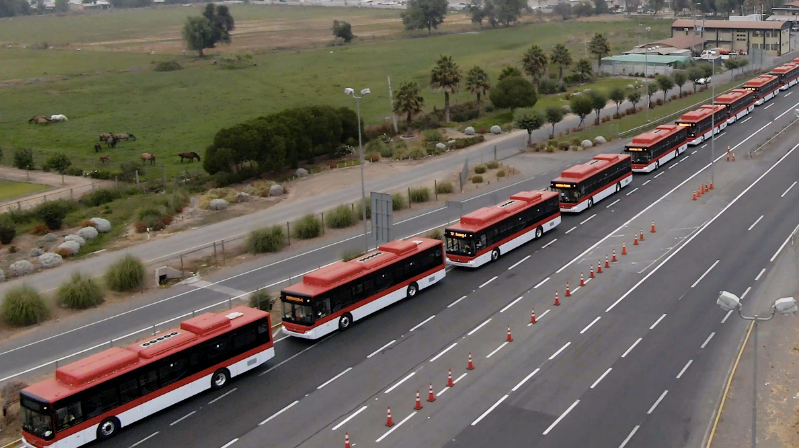
In overseas markets, Yutong's new energy buses are also popular. As early as 2018, the export of 100 pure electric buses in Yutong set a new record for overseas new energy buses, and also marked the official beginning of the electrification of public transportation in Chile. In July this year, Yutong high-end pure electric bus T13E was launched in Chile and delivered globally.
The relevant person in charge of Yutong Bus said: "In the field of new energy buses, it has steadily developed the international market. It has successfully demonstrated operations in France, the United Kingdom, Bulgaria, Chile and other markets, and has been in France, the United Kingdom, New Zealand, Mexico, Qatar, Norway, etc. The market has formed large-scale sales and good market reputation." At present, Yutong bus new energy products are exported to more than 40 countries and regions in the world.
The changes in the bus industry are irreversible, but how to break through the difficult situation and find a new way out is a compulsory course for enterprises in it.
Noticias populares
Social Media
Contact Information
Add: 6F-8F, Building #6-2, Anren Industrial Park, Xiamen City, Fujian Province, China
E-mail: market@amoymn.com
After-sales email: services@amoymn.com
All Rights Reserved © 2024 Xiamen Magnetic North Technology Co., Ltd.
